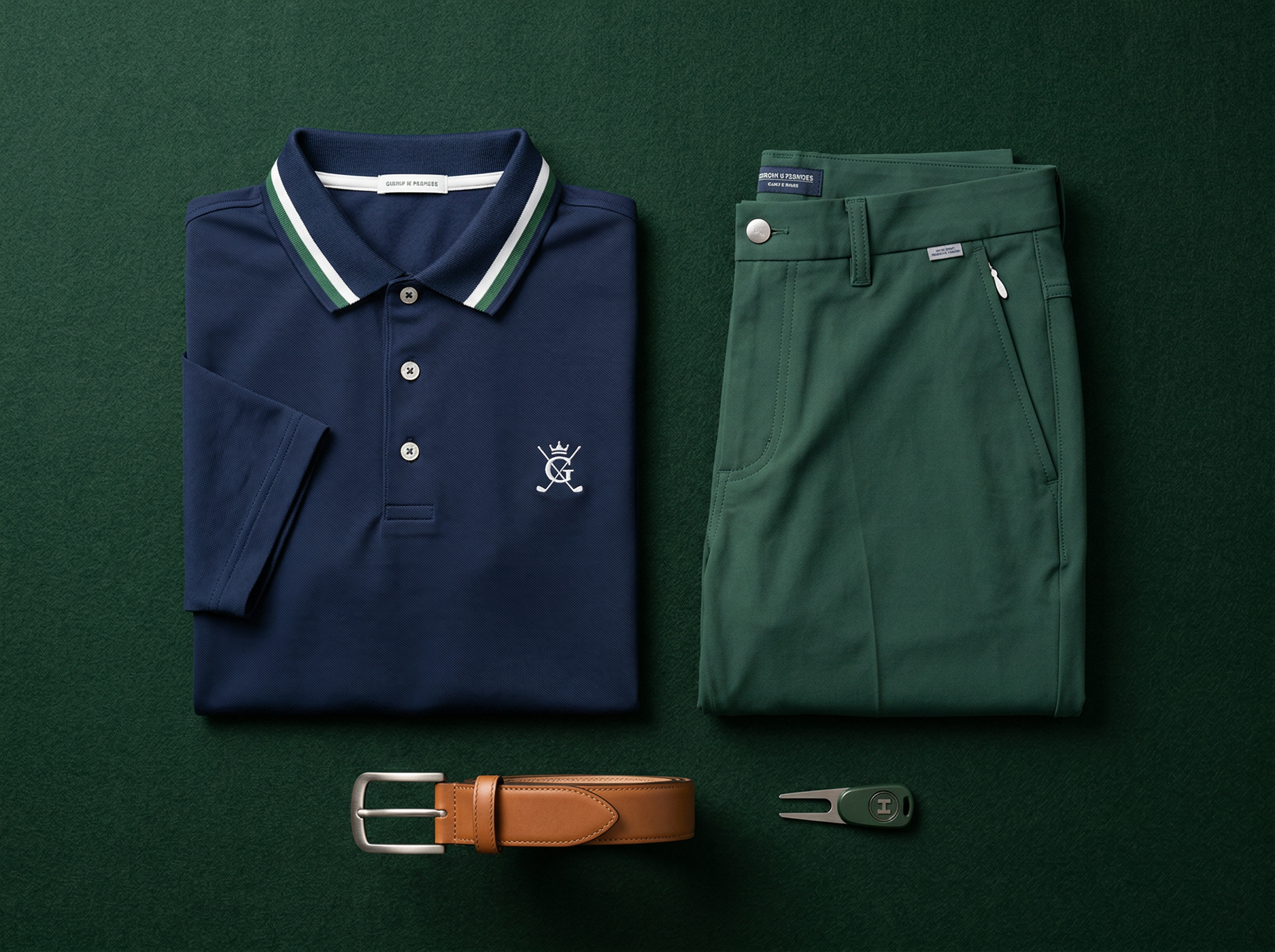
The golf polo is the most worn garment in any golfer's wardrobe and, paradoxically, the one that receives the least informed purchasing decisions. Most golfers buy on colour or brand recognition. Few buy on fabric performance, fit mechanics, or sun protection rating — the factors that actually determine how comfortable you are at the 16th hole of a coastal round in 30-degree heat. This guide addresses all of them.
Fabric: Moisture-Wicking vs Cotton
The single most consequential choice in golf polo selection is fabric technology, and the comparison almost always comes down to moisture-wicking synthetic performance fabrics versus natural cotton.
Moisture-wicking polyester blends (the category covering most major performance golf brands) are engineered to move sweat away from the skin surface and accelerate evaporation. In practice, this means the shirt feels dry even when you are perspiring, which matters enormously on a tropical course or a hot summer round in Australia. These fabrics are lightweight, wrinkle-resistant, and hold their shape across a full round of movement. They launder well and dry quickly. Their limitation: in very high heat, some cheaper versions can trap heat against the skin rather than dissipating it. Look for fabrics with open-weave or mesh panel construction if you are primarily buying for hot-climate play.
Cotton polos are softer against the skin, more breathable in dry heat, and tend to look more refined off-course. Their limitation for golf is significant: cotton absorbs moisture and holds it. A cotton polo after 18 holes in summer or tropical conditions is heavy, damp, and uncomfortable. For cooler, overcast conditions — a morning round in Hanoi in February, say — a quality cotton polo is excellent. For Da Nang in March or a summer round in Queensland, performance synthetic is the more functional choice.
Cotton-polyester blends attempt to split the difference, and the better ones (60/40 or 50/50 in quality constructions) succeed reasonably well — better performance than pure cotton in moderate conditions, softer feel than pure synthetic.
UPF Sun Protection: Why It Matters for Golf
Most golfers apply sunscreen to the face, neck, and forearms and consider the job done. What they miss is that standard polo fabric — particularly white cotton — provides minimal UV protection. A white cotton polo has an effective UPF of approximately 5-7, meaning it blocks around 80% of UV radiation. A UPF 50+ fabric blocks 98%. This difference accumulates across a round, a week, and a season of golf.
For golfers spending 4+ hours outdoors per round in high UV environments — tropical Asia, coastal Australia, New Zealand's summer — choosing a polo with a genuine UPF rating is a meaningful health decision as much as a comfort one. Most premium golf polo brands now include UPF ratings in their specifications. Look for UPF 30 as the minimum and prefer UPF 50+ for tropical play.
The ASEAN Links apparel range is designed with this in mind — the fabrics used in the ASEAN Links collection are selected for performance in the conditions our tours operate in: high UV, moderate-to-high heat, and the need for a shirt that looks presentable at a premium clubhouse restaurant after the round as well as on the tee box.
Collar Styles and Their Trade-Offs
Golf polo collar styles have diversified considerably from the traditional ribbed flat collar. The main options:
- Classic ribbed collar: The original. Stands up naturally, looks traditional and clean. Suits conservative dress codes at premium venues. Slightly bulkier under the chin during the backswing.
- Performance collar (semi-structured): Lighter construction, lays flatter, does not restrict head movement during the swing. Preferred by most competitive amateur golfers and tour professionals.
- Mock neck or stand collar: A minimalist option that eliminates the traditional polo collar structure entirely. Provides a cleaner modern aesthetic. Check dress codes at your intended venues before committing — some traditional clubs specify a conventional collar.
Fit: Athletic vs Relaxed
Athletic fit polos are cut closer to the body through the chest and torso. They look sharp on course and off, photograph well, and are the dominant choice among under-50 golfers who play regularly. The trade-off: they require a realistic assessment of your own proportions. An athletic fit polo that is too snug across the shoulders or chest will restrict your swing rotation — the opposite of the desired outcome.
Relaxed or classic fit polos are cut more generously through the body. They are more forgiving on physique and provide complete freedom of movement. The trade-off is visual: a relaxed-fit polo can look untucked and voluminous, particularly in lighter colours.
A well-fitted polo of either cut should allow full arm rotation, tuck cleanly into your waistband without bunching, and show no pulling across the shoulders at address. If the polo lifts away from your trousers during the backswing, size up or seek a longer-cut version.
Colour, Pattern, and Off-Course Versatility
Solid colours in navy, white, grey, and olive are the most versatile — they work from the driving range to the clubhouse restaurant without requiring a change. Brighter solids (red, royal blue, orange) work well on course but are harder to carry into dinner without looking conspicuously athletic. Patterns (stripes, geometric prints, texture weaves) can be excellent but are more specific in their context — a bold stripe that works at a beach resort looks overdressed at a conservative members' club.
For a tour like the ASEAN Links itinerary, where the same wardrobe has to function across golf courses, casual restaurants, temple visits, and riverside dinners, the muted solid colour polo in a performance fabric is the most practical foundation. The ASEAN Links apparel range is designed with exactly this versatility in mind.
Care and Longevity
Performance polyester polos should be washed in cold water on a gentle cycle and air-dried rather than tumble-dried. Heat degrades the elastic fibres and the moisture-wicking treatment over time. A well-cared-for performance polo maintains its shape and performance through 100+ wash cycles. Avoid fabric softeners — they coat the fibres and progressively reduce wicking efficiency.
Cotton and cotton-blend polos tolerate more conventional laundering but should still be kept out of high-heat dryers where possible. Quality cotton fades and loses collar structure faster than synthetics; air drying extends garment life significantly.