
Golf Courses
Laguna Golf Lăng Cô Review: Faldo Strategy and Local Advice
A practical guide to Sir Nick Faldo’s 6,961-yard course between Da Nang and Hue, including the changing terrain, shot strategy, transfer timing and best way to include it in a longer trip.
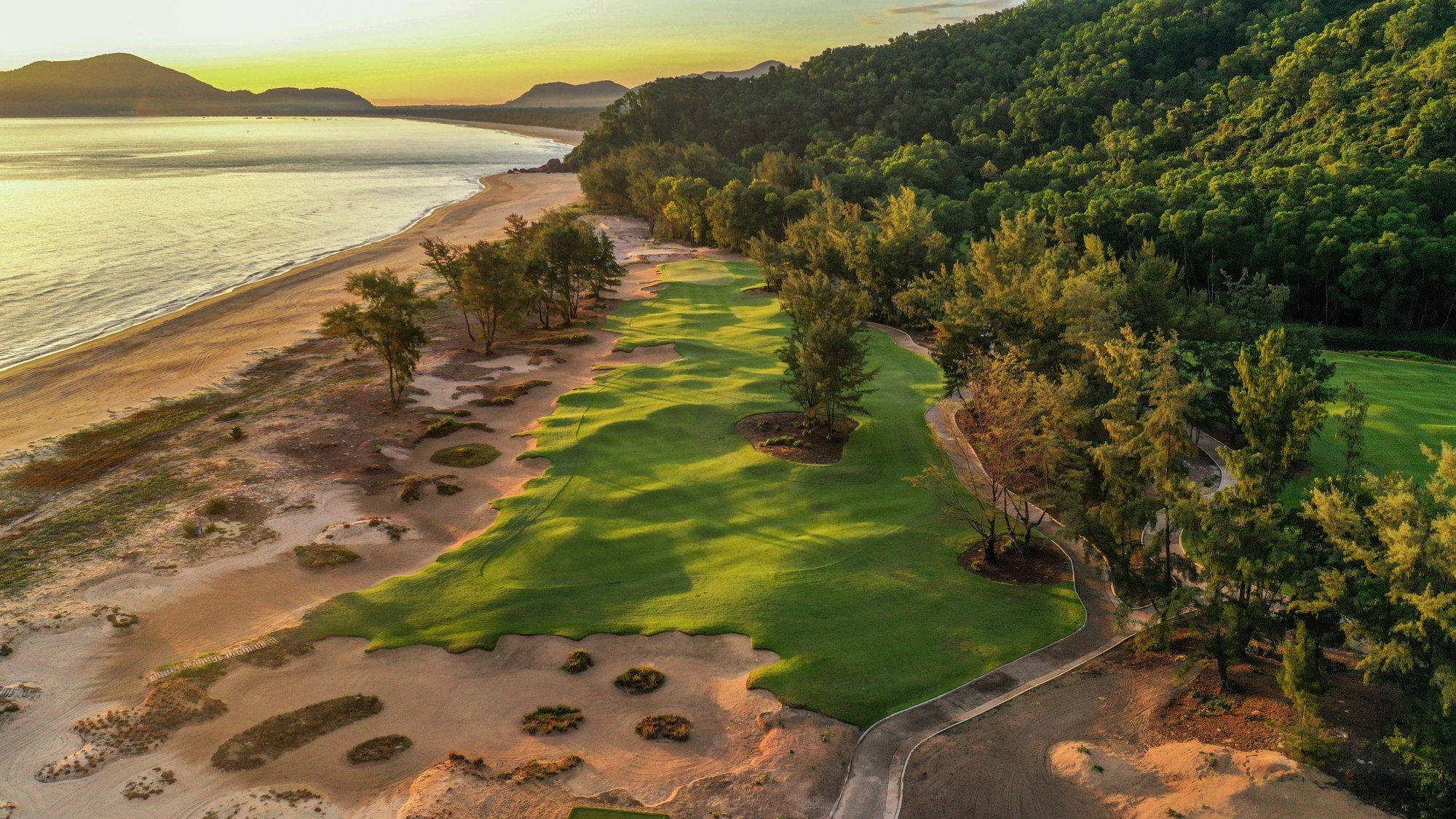
Laguna Golf Lăng Cô is the course in Central Vietnam that changes character most often during a single round. The routing moves through open rice-field terrain, beside streams and rock features, toward mountain vegetation and through coastal ground. The variety is not a marketing description added after construction. It is the main architectural idea.
Sir Nick Faldo’s par-71 layout measures 6,961 yards from the championship tees and 5,178 yards from the forward tees. Those numbers create a useful spread for mixed groups. Strong golfers face enough length and positional demands from the back, while social golfers can choose a tee that brings the intended landing areas into reach without removing the strategic decisions.
Laguna is farther from Da Nang and Hoi An than the central cluster, so it needs better planning. I would not squeeze it into a short trip simply to add another course name. It works best in a nine or ten-night itinerary, or with an overnight stay at Banyan Tree Lăng Cô, Angsana Lăng Cô or another property inside the resort precinct.
Course Design and Architectural Philosophy
Faldo uses an out-and-back concept and lets the terrain establish distinct groups of holes. The opening section introduces water and open ground. The course then moves closer to wooded and mountainous areas before reaching the coast and returning through more exposed terrain. Players must keep adjusting rather than relying on one stock strategy for 18 holes.
The design rewards the correct side of the fairway. A drive in play can still leave an uncomfortable angle if it finishes close to a tree line, stream or bunker that blocks part of the green. Before every tee shot, identify where the next shot needs to come from. That question is more useful than simply asking how wide the fairway is.
Faldo also leaves room for lower shots and controlled release. Zoysia fairways can support a firm strike and, when conditions allow, a running approach. The option becomes valuable when the wind rises near the coast. Golfers who only see the flag and fly every shot directly at it miss several of the design’s best solutions.
Hole-by-Hole Highlights and Signature Challenges
Holes 1 to 4: establish distance and position
The first four holes provide an immediate range of tasks. The opener is a strong par 4 that reaches 422 yards from the back tee. The second is a shorter par 4, followed by the 564-yard par-5 third. Hole 4 is a long par 4 of 471 yards from the championship tee. Do not let the varied terrain distract from a simple early goal: put the ball on the correct side of the fairway and learn the day’s carry distances.
The long fourth is a hole where par is a good score. Choose a tee that gives the group a realistic chance to reach the green in regulation. From too far back, the hole can become a forced sequence of maximum swings and remove the design choices.
The par 3s: changing wind and visual scale
Hole 5 measures up to 206 yards, while the eighth plays to 162 yards. The contrast continues on holes 11 and 14. Club selection must account for the protection provided by trees, the exposure near open ground and the different visual backgrounds. A green framed by mountain vegetation can look closer than an equally long target against open sky.
On the par 3s, ask for the front carry and the location of the safest miss. A flag near the edge of a large green does not require a direct attack. The centre target often leaves a makeable putt and removes the worst short-sided recovery.
Holes 14 to 18: finish with discipline
The 14th is a par 3 of up to 201 yards, followed by a 545-yard par 5. Hole 16 is a strong par 4 reaching 410 yards, and the 17th stretches to 457 yards. The 18th is a 621-yard par 5 from the championship tee and 568 yards from the next set forward. That closing sequence asks for patience.
The 18th is not automatically a two-shot hole simply because the group wants a dramatic finish. Decide after the drive. If the lie, wind and carry are not all favourable, play to the best wedge yardage. A full third shot from the fairway produces more birdie chances than a low-percentage second shot from a poor lie.
Local Conditions: Wind, Turf, Greens and Seasonality
The course was established with Zoysia fairways and TifEagle Bermuda greens. Zoysia can produce a clean, slightly raised lie in the fairway, but it also creates resistance around the green when the ball sits down. Test a bump-and-run, a standard chip and a short pitch during the warm-up. One technique will not suit every lie.
The putting surfaces can show Bermuda grain, particularly on subtle putts where the slope is not dominant. Ask the caddie for an initial read, then use the speed you observed on the practice green. The best approach is collaborative. A caddie can identify the local influence, while the golfer still needs to choose a pace that matches the intended line.
Mountains and coast create local weather variation. The course may receive cloud or rain at a different time from Da Nang. Early starts provide more schedule margin and are particularly valuable for day-tripping groups. The club advises that tee times after 12:30 pm from December to February and after 1:00 pm from March to November may not complete 18 holes before darkness. That is a practical reason to avoid building a long morning tour before the round.
October to December is the period that normally demands the most weather flexibility in Central Vietnam. During warmer months, an early tee time reduces heat. From December into February, bring a light layer for the morning transfer and check the forecast for wind and rain at Lăng Cô, not only Da Nang.
Caddie Insights and On-Course Strategy
Because the course changes terrain, the caddie’s knowledge becomes more useful as the round progresses. Confirm yardage units on the first tee. On later holes, ask how the wind behaves beyond visible trees or rock features. A sheltered stance can hide what the ball will encounter near the green.
- Choose a fairway side based on the next shot, not only the nearest hazard.
- Ask whether a running approach is available when the wind is against you.
- On par 5s, select the lay-up distance before choosing the second-shot club.
- Keep long putts below the hole where the green has several tiers.
- Use the forward tees when they create the intended carry and landing zones.
For a group event, explain the format to the caddies before the first tee. Stableford, two-ball aggregate, scramble and match play create different priorities. When everyone understands the game, scoring and pace improve.
Clubhouse Facilities, Practice Grounds and Dining
The clubhouse overlooks the course and supports both daily golf and larger tournament groups. The club lists 180 men’s lockers and 123 women’s lockers, which gives it useful capacity for organised events. Golf Café provides Western and Asian options, while the pro shop covers standard golf essentials.
The practice facilities include a long-game range, putting and chipping areas, plus a separate mini putting course. Current published practice prices show 55 range balls at VND 150,000 and unlimited adult range use at VND 500,000, although rates can change. For a visiting group with a confirmed tee time, ASEAN LINKS checks what warm-up access is included before travel.
Plan to arrive at least 45 minutes early. Larger groups should allow an hour. The drive is part of the day, and going directly from the vehicle to the first tee removes the chance to loosen up, assess the turf and organise competition cards.
Logistics: How to Get There and Transfer Times
Laguna Golf Lăng Cô is north of Da Nang, beyond the main central course cluster. From Da Nang International Airport or a central city hotel, allow roughly 60 to 90 minutes depending on the route, pickup point and traffic. From the My Khe beach area, 75 to 90 minutes is a safer group-planning allowance. From Hoi An, allow approximately 90 to 110 minutes.
The Hai Van Tunnel is normally the practical route for a golf transfer. The Hai Van Pass is scenic but adds time and should be treated as a touring option rather than the default route to a fixed tee time. A private transfer is strongly preferable for groups because it keeps players, luggage and clubs together and allows the return departure to follow the actual finish.
The club asks players to arrive at least 30 minutes before the tee time. ASEAN LINKS normally builds more margin than that, especially for 12 or more golfers. If the group is staying at Laguna Lăng Cô, the transfer problem disappears and an early tee time becomes much easier.
How to Include Laguna Golf Lăng Cô in Your Golf Itinerary
Laguna is a core round in the 10-day LINKS Discovery holiday. That format has enough time for five courses, Hoi An, Hue and recovery days. It avoids turning a distinctive round into a long bus day inside an already compressed schedule.
For a custom trip, consider one or two nights at Banyan Tree or Angsana Lăng Cô. Golfers can play early while non-golfers use the resort, then the whole group can continue toward Hue or return to Da Nang. The overnight version costs more than a simple day trip, but it uses time better and usually produces a more relaxed round.
ASEAN LINKS can confirm the course, private transfer and accommodation through one itinerary. If you only need the round, submit a request through Central Vietnam golf bookings. Every proposal states the cart, caddie, transfer and payment conditions clearly.
Frequently asked questions
Laguna Golf Lăng Cô FAQs
How far is Laguna Golf Lăng Cô from Da Nang?
Allow roughly 60 to 90 minutes from Da Nang depending on the exact hotel, traffic and route. Groups staying around My Khe Beach should normally plan on 75 to 90 minutes.
Is it better to stay overnight at Laguna Lăng Cô?
For a longer itinerary, yes. One or two resort nights allow an early tee time, reduce time in the vehicle and make it easier to combine the course with Hue.
What is the course length and par?
Laguna Golf Lăng Cô is an 18-hole, par-71 course measuring 6,961 yards from the championship tees and 5,178 yards from the forward tees.
What is the best tee time?
Morning is best for most visiting groups. It provides more weather and daylight margin and avoids the risk of a late afternoon round finishing in darkness.
Is Laguna suitable for mixed handicaps?
Yes. Its wide spread of tee yardages lets mixed groups select suitable landing zones while retaining the strategic character of the course.
Sources and updates
Course specifications and operating information were checked against the club’s official material and the supporting sources below. Conditions, policies and travel times can change, so ASEAN LINKS reconfirms the important details before travel.
Make the Lăng Cô day worthwhile
Plan Laguna with the right transfer, tee time and hotel
Tell Jerram whether you prefer a day trip or an overnight resort stay. ASEAN LINKS will build the golf, private transport and surrounding itinerary around your group.