
Beyond Golf
My Son Sanctuary Guide
An hour inland from Hoi An, in a valley ringed by jungle-covered hills, stand the red-brick ruins of the Champa kingdom's spiritual capital: Vietnam's most significant ancient site and a half-day that deepens any central-coast golf trip.
What My Son is
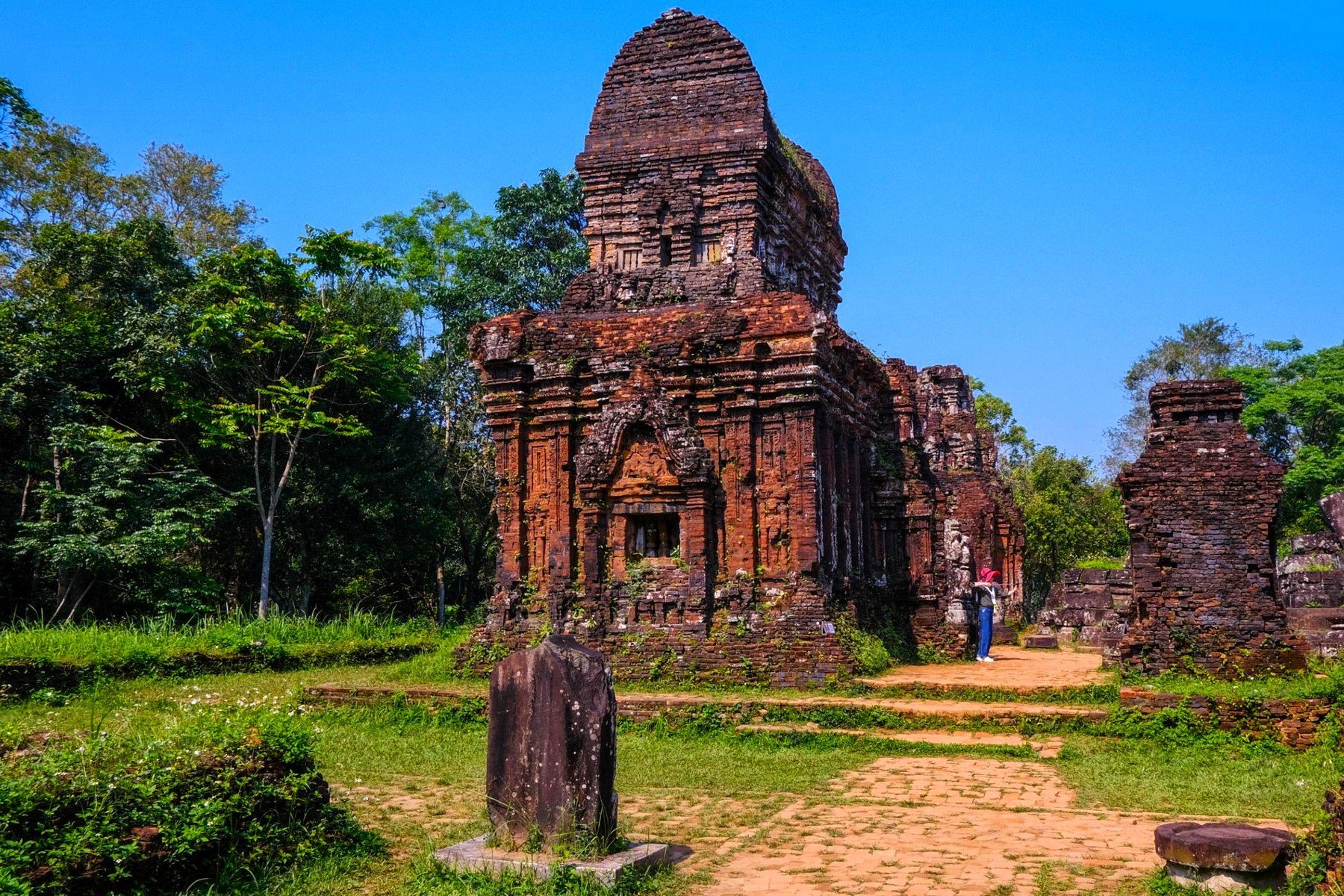
Between the 4th and 13th centuries, the Cham people: Hindu seafarers who ruled much of central Vietnam from their coastal cities: built their religious centre at My Son, a valley they chose for its mystical geography: mountains cupping a sacred plain, a stream running through it. Over seventy temple towers of brick and stone rose here, dedicated to Shiva in his various forms. Abandoned after the 13th century and absorbed back into the jungle, the site was rediscovered by French scholars in the late 19th century: and then, brutally, marked by bomb craters in the American war, when the valley's remoteness made it a hiding place. Today it is a UNESCO World Heritage site, and what survives is haunting: towers of a fired-brick technique scholars still cannot fully replicate, linga altars, and carhes of dancers and gods.
What you will see
The temples group into clusters lettered by archaeologists. Group B, C and D form the heart: the kalan (sanctuary towers) with their weathered sandstone doorframes and carved lintels, brick courses fused so precisely that no mortar was needed. The on-site museum adds the recovered sculpture: Shiva heads, apsara reliefs, the famous pedestal carved with elephants that scholars consider among Cham art's finest work. Traditional Cham dance performances run several times daily near the entrance; worth fifteen minutes for the costuming alone.
Getting there and around
My Son lies about 40 kilometres west of Hoi An: roughly an hour by road through rice-paddy country. The practical pattern is a morning visit, before the heat and the tour buses: leave Hoi An by 7:30, walk the valley as the light comes over the hills, and be back for lunch. Some tours combine it with a boat return down the Thu Bon river past craft villages; pleasant, slower, and a good option when the golf schedule allows. The paths are flat but exposed: hats and water, as always.
Pairing it with your golf days
My Son fits the rest-day slot between rounds, or the afternoon of an early finish at Vinpearl Nam Hoi An, which lies on the same side of Hoi An. It pairs naturally with the Hoi An old town: the sanctuary supplies the deep history the trading port continued. Groups with a keen historian should take a guide; the carvings explain themselves only partially.
Common questions
Is it worth it for non-history buffs?
Yes: the setting alone justifies the hour, and the scale of what a medieval kingdom achieved with brick is quietly astonishing. Budget two hours on site; keen historians linger longer.
Can we visit in the wet season?
The valley drains well and an umbrella hour can be atmospheric rather than miserable, but the exposed paths get slick: dry-season mornings are the quality choice.
History in brief
Understanding My Son takes one idea: the Cham were a maritime Hindu kingdom, culturally tied to India by trade and to the sea by geography, squeezed between Vietnam to the north and the Khmer to the south. For a thousand years they held this coast, building port-cities like Hoi An's predecessor and temple-mountains like My Son, where their kings were buried and their gods honoured. The kingdom faded by the 15th century, absorbed into the Vietnamese state that moved south: but the brick towers, fired in a technique modern engineers still puzzle over, remain among Southeast Asia's great archaeological survivals.
Booking the visit
My Son is an easy self-guided half-day from Hoi An, but a guide materially improves it: the lintel carvings and brickwork reward explanation. We include the visit on most central-coast itineraries on request, sequenced with your tee times so the rest day still contains a swim. The site opens early; the first hour of light across the towers is the one worth setting an alarm for.
Planning Your Visit
My Son rewards an early start. The site opens in the morning, the light is better for photographs, and the coach groups from Da Nang and Hoi An arrive later: visitors who reach the ruins by eight-thirty often have the first hour almost to themselves. The visit pairs naturally with a morning round nearby; several of the Hoi An-side courses lie within half an hour, making a play-then-tour (or tour-then-play) day entirely practical. Wear sturdy shoes: the ground is uneven and can be slippery after rain: and bring water; the site is largely unshaded.
How Long to Allow
Most visitors spend two to three hours on site: one loop through the temple groups with a guide, time at the small museum, and a pause at the viewpoint overlooking the valley. Add transfer time from Da Nang (around 90 minutes round trip) and the half-day fills comfortably. Guided visits add considerably to the experience: the Cham history and the bombing scars are not self-explanatory: and guides are available at the entrance. Confirm current opening hours and any restoration closures with the site's official channels before you travel.